
Table of Contents
Introduction
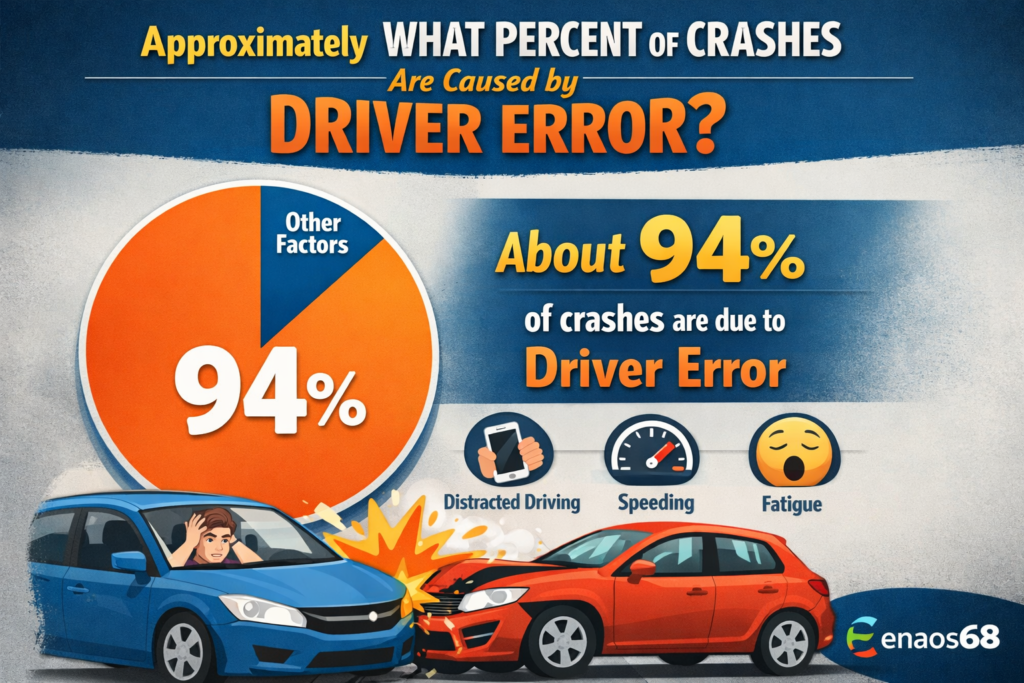
Understanding approximately what percent of crashes are caused by driver error is critical for every driver, road safety expert, and policymaker. Traffic accidents are often life-changing events, and knowing the main causes can help prevent future collisions. Research consistently shows that human mistakes behind the wheel, such as distracted driving, poor judgment, fatigue, and speeding, contribute to the overwhelming majority of car accidents. In fact, multiple studies indicate that driver error accounts for nearly 90–94% of all crashes, highlighting how important it is to focus on safe driving habits. While road conditions, weather, and vehicle malfunctions do play roles in some accidents, human factors remain the central cause in most cases. By examining the nature of these errors and understanding how they impact accident statistics, drivers can take proactive steps to improve safety, reduce risks, and protect both themselves and others on the road. This article explores the key aspects of driver error, the statistics behind crash causes, and actionable tips for minimizing risks, helping readers grasp the real impact of human mistakes behind the wheel.
What Does “Driver Error” Mean in Traffic Crash Statistics?
When we talk about driver error in traffic crash statistics, we are referring to mistakes made by a human behind the wheel that directly contribute to an accident. Unlike mechanical failures, poor road conditions, or weather-related incidents, driver errors are actions or inactions that could have been prevented with better awareness, decision-making, or skill. These errors range from misjudging the distance of another vehicle to reacting too slowly to a traffic signal, failing to yield, or even minor distractions like checking a phone or adjusting the radio. Researchers often categorize driver errors into recognition errors, decision errors, and performance errors. Recognition errors occur when a driver fails to notice a hazard, such as missing a stop sign or not seeing a pedestrian crossing. Decision errors happen when a driver notices a hazard but responds incorrectly, such as attempting to pass another car unsafely or miscalculating the speed of oncoming traffic. Performance errors are when a driver intends to act correctly but executes the maneuver incorrectly, like oversteering or braking too late. Understanding these categories helps researchers and policymakers see not only that driver error causes a high percentage of crashes, but also the ways in which human behavior contributes to accidents on a practical level.
The concept of driver error is also nuanced because many accidents involve multiple contributing factors. For example, a slippery road may make a crash more likely, but if the driver is alert, drives at a safe speed, and maintains proper control, the accident might be avoided. In most crash reports, human error is identified as the “critical reason” for the collision, meaning that even when environmental factors exist, the primary cause is still traced back to a human decision or mistake. Studies by agencies like the National Highway Traffic Safety Administration (NHTSA) consistently show that approximately 90–94% of crashes are caused by driver error, emphasizing that improving driver behavior can have a significant impact on road safety. By recognizing the patterns of errors and understanding how they lead to accidents, drivers can become more proactive, adopting strategies to anticipate hazards, reduce distractions, and make safer decisions in everyday driving. This understanding forms the foundation for defensive driving education, public safety campaigns, and technological advancements aimed at reducing the number of accidents caused by human mistakes.
How Much of All Crashes Are Caused by Driver Error (Data & Research)
When we look at crash statistics, the numbers are both striking and revealing. Research consistently shows that driver error is responsible for the vast majority of vehicle accidents, with estimates often ranging from 90 to 94 percent of all crashes. These figures come from detailed investigations conducted by organizations such as the National Highway Traffic Safety Administration (NHTSA) in the United States, which studies the causes of traffic collisions through extensive crash reports and field analyses. Driver error encompasses a wide range of behaviors, including distracted driving, speeding, failure to yield, aggressive driving, and impaired judgment due to fatigue or alcohol. While mechanical failures, poor road conditions, or weather hazards do contribute to accidents, studies indicate that in almost every crash, human decisions and mistakes play a critical role in either causing or worsening the incident. For instance, in rear-end collisions, failure to maintain a safe following distance—a clear driver error—accounts for a significant portion of crashes, whereas in intersection accidents, misjudging the timing of traffic lights or failing to yield are common errors leading to crashes. The consistent finding across multiple studies is that human error, more than any other factor, drives the high rates of accidents on our roads, and understanding this is essential for anyone who wants to reduce their risk behind the wheel.
Breaking down the statistics further, driver errors are often categorized into recognition errors, decision errors, and performance errors, with each contributing differently depending on the type of accident. Recognition errors, such as failing to notice a pedestrian or another vehicle, are among the most frequent causes of collisions, while decision errors, like attempting to pass unsafely or misjudging speed, often lead to high-severity crashes. Performance errors, including overcorrecting or braking too late, are common in conditions where the driver is inattentive or inexperienced. The research also emphasizes that while approximately what percent of crashes are caused by driver error may sound abstract, the impact is tangible: thousands of lives are affected every year by mistakes that could have been avoided with proper attention, skill, and caution. Even more importantly, these statistics are not just numbers—they represent real-world patterns that highlight the critical need for better driver education, awareness campaigns, and technological solutions such as collision avoidance systems. By examining the data carefully, it becomes clear that addressing driver behavior, rather than focusing solely on vehicles or infrastructure, is the most effective way to reduce accidents, save lives, and create safer roads for everyone.
Why Driver Error Is the Leading Cause of Collisions
Driver error remains the leading cause of traffic collisions because human behavior behind the wheel is unpredictable and often flawed. Unlike vehicles or roads, which are designed and maintained according to strict safety standards, drivers vary widely in skill, attention, and decision-making. Factors such as distraction from smartphones, fatigue from long hours on the road, aggressive driving, or simple lapses in judgment can drastically increase the likelihood of a crash. Studies have shown that even experienced drivers are not immune to mistakes, and under certain conditions, nearly anyone can make a critical error that leads to an accident. For example, a momentary glance at a phone while driving at highway speeds can mean the difference between safely stopping and causing a multi-vehicle collision. Speeding, which reduces reaction time and increases the severity of crashes, is another major contributor, and it is often intertwined with other human errors, such as tailgating or misjudging traffic signals. These behavioral patterns explain why approximately what percent of crashes are caused by driver error is so high, and they underline the importance of focusing on human factors in road safety programs rather than relying solely on technological or infrastructural solutions.
The leading role of driver error is also evident when examining the types of crashes that occur most frequently. Single-vehicle accidents, such as running off the road or hitting stationary objects, are overwhelmingly caused by mistakes like oversteering, distraction, or falling asleep at the wheel. In multi-vehicle accidents, errors such as failing to yield, unsafe lane changes, and misjudging the speed and distance of other cars dominate. Additionally, research shows that driver errors are often compounded under stress, poor weather, or heavy traffic, increasing both the likelihood and severity of crashes. While road conditions and vehicle malfunctions can contribute to accidents, the underlying cause in nearly every scenario traces back to human behavior. This explains why traffic safety campaigns, defensive driving courses, and modern driver-assistance technologies focus heavily on correcting or compensating for driver error. By understanding the reasons behind these mistakes and addressing them through education, awareness, and technological support, it becomes possible to significantly reduce the number of collisions and save lives, demonstrating the critical connection between human behavior and the high percentage of accidents attributed to driver error.
How Crash Percentages Vary by Crash Type
The percentage of crashes caused by driver error can vary depending on the type of accident, but in nearly every category, human mistakes remain the dominant factor. In single-vehicle accidents, which include incidents like running off the road, hitting stationary objects, or losing control on curves, driver error is almost always the primary cause. These crashes often occur due to fatigue, distraction, speeding, or impaired judgment, and they illustrate how a single lapse in attention can have serious consequences. In contrast, multi-vehicle crashes, such as rear-end collisions, side-impact accidents, or intersection crashes, are also overwhelmingly influenced by driver behavior. Failing to maintain a safe distance, misjudging gaps in traffic, improper lane changes, and running red lights are all examples of driver errors that lead to these accidents. Even when environmental factors like slippery roads or poor visibility are present, studies show that driver error remains the critical factor in initiating the crash. This variation in crash type demonstrates that while circumstances may differ, human mistakes consistently play a central role, explaining why approximately what percent of crashes are caused by driver error remains such a high figure across all accident categories.
The severity and frequency of accidents also influence the role of driver error in different crash types. Rear-end collisions, for example, are extremely common and often caused by inattentiveness or tailgating, while intersection crashes frequently involve decision errors, such as misjudging the timing of lights or turning across traffic. Single-vehicle accidents tend to involve performance errors or momentary lapses in judgment, while multi-vehicle collisions often result from a combination of recognition and decision errors. Fatal crashes, although less common than minor accidents, are heavily influenced by driver error, with impaired driving, speeding, and distracted driving being leading contributors. This demonstrates that regardless of the type, location, or circumstances of the crash, driver error consistently plays a primary role in causing accidents. Understanding these differences not only helps in interpreting crash statistics more accurately but also provides critical insights for drivers, policymakers, and road safety advocates who aim to reduce accidents through education, enforcement, and technological interventions designed to compensate for human error.
Regional & International Differences in Driver Error Rates
While driver error is universally recognized as the leading cause of traffic crashes, the percentage of accidents attributed to human mistakes can vary between regions and countries due to differences in road infrastructure, traffic laws, driver education, and cultural attitudes toward driving. In countries with rigorous licensing systems and strong traffic enforcement, such as Germany or Sweden, the proportion of crashes caused by driver error may appear slightly lower than the global average, though human mistakes still dominate crash statistics. In contrast, regions where road safety regulations are less strict or where driver training is minimal often report higher rates of accidents stemming from inexperience, aggressive driving, or lack of awareness. Environmental and societal factors, such as weather conditions, urban density, and the prevalence of distracted driving behaviors, also influence these variations. Despite these differences, studies consistently confirm that approximately what percent of crashes are caused by driver error remains high across the world, generally ranging from 85 to 94 percent depending on the methodology and scope of the research. This emphasizes that human behavior behind the wheel is a critical factor in road safety no matter where the driving occurs.
International comparisons also highlight how cultural attitudes and technological adoption affect the rate of driver errors. For example, countries that have implemented advanced driver-assistance systems, stricter drunk-driving laws, and widespread public awareness campaigns often see measurable reductions in certain types of driver errors, such as impaired driving or speeding. However, even in these regions, errors like distraction, poor judgment, and fatigue continue to contribute heavily to crash statistics. Case studies from regions with high traffic density, such as India or Brazil, show that driver error compounded with challenging road conditions and inconsistent traffic rule enforcement can lead to much higher accident rates, illustrating the interplay between human mistakes and environmental factors. Understanding these regional and international differences is essential for policymakers and safety advocates because it shows that while infrastructure and law enforcement can reduce risk, the core solution still lies in addressing human behavior. Ultimately, the global data reinforce the conclusion that driver error is the main contributor to crashes worldwide, and improving driver awareness, training, and responsible behavior remains the most effective strategy for reducing accidents across all regions.
Misunderstandings Around Driver Error Statistics
Despite extensive research showing that driver error is responsible for the vast majority of traffic crashes, many people misunderstand what these statistics actually mean. A common misconception is that driver error causes 100% of all crashes, which oversimplifies a more complex reality. In truth, while human mistakes are involved in nearly every collision, other factors such as poor weather conditions, mechanical failures, and road design issues can contribute to the severity or likelihood of a crash. The statistic that around 90 to 94 percent of crashes are caused by driver error refers to the primary or critical factor identified in crash investigations, meaning that human behavior is usually the main cause even when other conditions play a role. Misinterpretation often leads to unfair blame being placed solely on drivers or an overreliance on technology, assuming that features like lane assist or automatic braking can fully eliminate crashes. Understanding that these numbers reflect the influence of human decisions rather than the sole cause helps drivers, insurers, and policymakers interpret crash data accurately and take meaningful steps to improve safety.
Another common misunderstanding involves the way driver error is categorized and reported. Crash reports often classify errors as recognition, decision, or performance-related, but these categories can overlap, making it challenging to pinpoint a single “cause” of a crash. For example, a driver who runs a red light may have failed to notice it due to distraction, misjudged the speed of oncoming traffic, or reacted too slowly—all forms of human error. Studies and statistics sometimes simplify these scenarios into one category, which can lead the public to believe that crashes are easier to prevent than they truly are. Additionally, variations in data collection methods across states and countries can result in slightly different percentages of driver error, fueling misconceptions about the reliability of the numbers. Despite these nuances, the overarching conclusion remains clear: driver error is the dominant factor in most crashes, and recognizing the limitations and context of these statistics is essential for improving road safety, guiding responsible driving habits, and informing policies that effectively address human behavior on the roads.
What This Means for Drivers & Road Safety
Understanding that approximately what percent of crashes are caused by driver error has direct implications for drivers and overall road safety. Recognizing that human mistakes are the leading cause of accidents highlights the importance of developing safe driving habits, maintaining focus on the road, and consistently anticipating potential hazards. Defensive driving becomes a critical skill, where drivers actively scan for risks, maintain safe distances, obey speed limits, and adjust behavior according to traffic and weather conditions. The data suggests that even small improvements in attention, reaction time, and decision-making can drastically reduce the likelihood of a collision. For example, avoiding distractions like smartphones, limiting driving while fatigued, and respecting traffic rules are simple measures that directly target the human errors responsible for most accidents. Road safety campaigns, driver education programs, and public awareness initiatives are all designed to address these human factors, reinforcing the idea that the majority of accidents can be prevented if drivers make conscious, safe choices behind the wheel.
Additionally, the understanding of driver error has influenced the development and adoption of modern vehicle technologies aimed at mitigating human mistakes. Features like lane departure warnings, adaptive cruise control, automatic emergency braking, and blind-spot detection are designed to compensate for lapses in attention or judgment, reducing the severity and frequency of accidents caused by human error. However, while technology can assist, it cannot replace the responsibility of the driver. The high percentage of crashes attributed to driver error underscores the need for continued education, disciplined driving practices, and a proactive approach to risk management. By integrating safe driving behaviors with the careful use of technology, drivers can significantly reduce their risk of involvement in an accident. On a broader level, policymakers and road safety organizations can use these insights to craft regulations, infrastructure improvements, and educational campaigns that specifically target the behaviors most commonly associated with crashes, demonstrating that addressing human error is the most effective strategy for creating safer roads for everyone.
Frequently Asked Questions (FAQs)
Many drivers and road safety enthusiasts often have questions about approximately what percent of crashes are caused by driver error and what that means for everyday driving. One common question is whether distracted driving alone accounts for the majority of crashes. Studies indicate that distraction is a leading contributor, but it is only one component of driver error, which also includes speeding, impaired driving, poor judgment, and fatigue. Another frequent question concerns fatal crashes, where people wonder if driver error is equally responsible. Research shows that human mistakes are even more critical in severe collisions, as errors like speeding, alcohol impairment, and misjudging traffic situations tend to lead to higher-risk crashes. Additionally, many ask whether advanced vehicle technologies can eliminate driver error. While features like lane assist, collision avoidance, and automatic braking reduce risks, they cannot replace the need for attentive and responsible driving. These FAQs highlight that understanding human error is essential for both preventing accidents and interpreting crash statistics accurately.
Another important question often asked is how weather or road conditions affect driver error. Although slippery roads, fog, or poor signage can contribute to crashes, studies consistently show that human decisions remain the critical factor in nearly all cases. For example, a driver who adjusts their speed, maintains safe distances, and stays alert can often prevent an accident even in adverse conditions. People also frequently ask about differences across regions and countries, and while statistics may vary slightly due to infrastructure, traffic laws, and cultural attitudes, the dominance of driver error is universal. Finally, drivers are often curious about what practical steps they can take to minimize their own risk. Education, defensive driving, regular breaks to prevent fatigue, and avoiding distractions are proven strategies that target the root cause of most crashes: human error. By answering these questions, drivers can better understand the significance of driver behavior, the real-world meaning behind the statistic that approximately 90–94% of crashes are caused by driver error, and the ways they can actively reduce their risk on the road.
Conclusion: Final Takeaways on Driver Error and Crash Rates
In conclusion, understanding approximately what percent of crashes are caused by driver error is essential for anyone who spends time on the road, whether as a daily commuter, professional driver, or occasional traveler. The overwhelming majority of vehicle accidents are linked to human mistakes, including distraction, poor judgment, speeding, fatigue, and impaired driving. While environmental factors, road conditions, and vehicle malfunctions do play a role in some collisions, research consistently shows that human error is the critical factor in 90 to 94 percent of crashes. This statistic is not just a number; it represents real-world patterns that can guide safer driving practices, more effective education programs, and informed policymaking. By focusing on the human element of driving, individuals and authorities can develop strategies that directly reduce risks and prevent accidents, highlighting the importance of responsible behavior, alertness, and awareness every time a vehicle is on the road. Understanding these realities encourages drivers to take personal responsibility for safety, demonstrating that most crashes can be prevented through conscientious decision-making and proactive measures.
Moreover, acknowledging the dominant role of driver error has broader implications for society, technology, and public safety initiatives. Advanced vehicle technologies such as lane assist, automatic braking, and collision detection are designed to complement human behavior, but they cannot replace the need for attentive driving. Education, defensive driving practices, and behavioral interventions remain crucial tools in reducing crashes. On a societal level, understanding that human error drives the majority of accidents can inform road design, traffic law enforcement, and public awareness campaigns, ensuring that interventions target the behaviors most likely to cause crashes. Ultimately, the high percentage of accidents caused by driver error serves as a clear reminder that safe driving is a shared responsibility, and by addressing the root cause of most collisions, we can make roads safer for everyone. Through awareness, education, and careful driving habits, the devastating impact of human mistakes behind the wheel can be significantly reduced, saving lives and fostering a culture of safety on roads worldwide.